
Feeding sachets by hand is often the slowest step before cartoning. Operators pick sachets from a bin, line them up and push them into the cartoner, and the whole line runs at their pace. A sachet sorter does that job automatically: it takes a heap of loose sachets and delivers them one by one, in the order and orientation the next machine needs.
This guide covers the five questions to answer before you choose a sorter, and compares our four models.
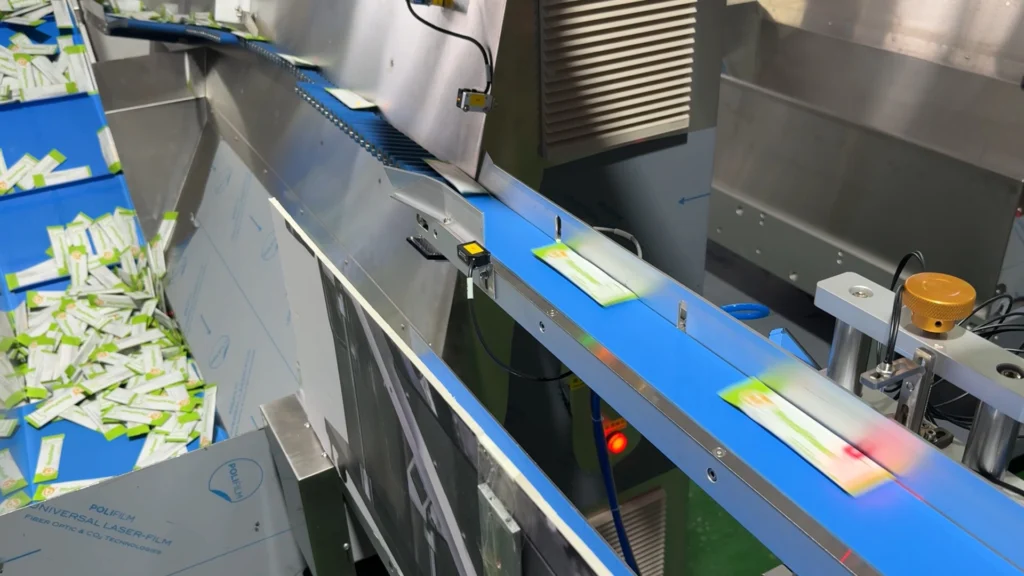
How a sachet sorter works
Loose sachets are tipped into a hopper. A conveyor carries them to a set of rollers running at low, medium and high speed. Because each roller runs faster than the one before, the sachets are pulled apart and leave the machine one at a time. The sorter then places them in the form, sequence or stack that the downstream machine expects, usually the infeed of a cartoner or a counting and packing line.
1. What speed does your downstream machine need?
Start from the machine after the sorter, not from the sorter itself. Multiply your cartoner speed by the number of sachets in each carton: a cartoner running 50 cartons per minute with 2 sachets per carton needs 100 sachets per minute. Leave some margin above that figure, because real speed depends on the sachet and its contents.
Then pick the model whose top speed covers it:
- Up to 100 sachets per minute: SBM-BS100A or SBM-BS100B
- Up to 300 sachets per minute: SBM-BS300
- Up to 400 sachets per minute: SBM-BS400
2. How big are your sachets, and what is inside?
Check your largest sachet against the machine’s bag size range. The BS100A and BS100B take sachets up to 180 mm long and 100 mm wide. The BS300 and BS400 take sachets up to 180 mm long and 120 mm wide.
Size is only part of it. Film stiffness, surface finish and fill (powder, granules, liquid or gel) all change how sachets slide and separate. Two sachets of the same size can behave very differently on the rollers. That is why we always recommend a test with your own samples.
3. How much floor space do you have?
The four models have different shapes, so the layout of your line matters as much as the total area.
- BS100A is long and narrow (about 2580 × 650 mm). It suits a straight, inline layout.
- BS100B is compact (about 1474 × 880 mm). It fits where the space in front of the cartoner is short.
- BS300 is about 2250 × 950 mm and runs on 380 V with compressed air (0.5–0.8 MPa).
- BS400 is about 2360 × 980 mm, for the highest output in a similar footprint.
4. Will the sorter work alone or as part of a line?
A sorter can run on its own, feeding a manual packing table, or connect directly to a cartoner or counting machine. If you are connecting it to a machine you already own, send us the model and a photo of its infeed. We will check the transfer height, orientation and signals between the two machines before we quote.
5. How often do you change products?
If you pack several sachet sizes on one line, ask how a size change is done, how long it takes, and which parts touch the product. For food and pharmaceutical lines, also ask how the contact parts are cleaned.
Model comparison
| SBM-BS100A | SBM-BS100B | SBM-BS300 | SBM-BS400 | |
|---|---|---|---|---|
| Drive | Servo-driven | Full servo | — | Full servo |
| Speed | Up to 100 sachets/min | Up to 100 sachets/min | 100–300 sachets/min | 100–400 sachets/min |
| Sachet size | L ≤ 180 mm, W ≤ 100 mm | L ≤ 180 mm, W ≤ 100 mm | L ≤ 180 mm, W ≤ 120 mm | L ≤ 180 mm, W ≤ 120 mm |
| Power | 3.0 kW | 3.0 kW | 5.5 kW | 4.8 kW |
| Voltage | 220 V, 50/60 Hz | 220 V, 50/60 Hz | 380 V, 50/60 Hz | 220 V, 50/60 Hz |
| Compressed air | — | — | 0.5–0.8 MPa, 100 L/min | — |
| Dimensions (L × W × H) | approx. 2580 × 650 × 1850 mm | approx. 1474 × 880 × 1850 mm | approx. 2250 × 950 × 1560 mm | approx. 2360 × 980 × 1640 mm |
| Weight | approx. 400 kg | approx. 400 kg | approx. 650 kg | approx. 700 kg |
Test with your own sachets
The surest way to choose is to see your own sachets on the machine. Send us a few hundred samples with your target output and the model of your cartoner or packing machine. We will run them, record a video and recommend the model and line layout that fit.
Request a machine proposal, browse all sachet sorting machines, or see how we build complete sachet sorting and counting lines.
FAQ
How fast can a sachet sorter run?
Our SBM-BS400 sorts up to 400 sachets per minute, the BS300 up to 300, and the BS100A and BS100B up to 100. The real figure depends on the sachet size, film and contents.
Can one sorter handle different sachet sizes?
Yes, within the machine’s size range. Tell us all the sizes you pack so we can confirm the changeover parts and time.
Can a sachet sorter connect to my existing cartoner?
In most cases, yes. Send us the cartoner model and a photo of its infeed, and we will check the connection before quoting.