
A cartoner takes a flat carton blank, opens it, puts your product inside and closes the carton, either by tucking in the flaps or by gluing them with hot melt. It replaces the slowest and most repetitive step at the end of many lines. The first decision is whether the product goes in from the side (a horizontal cartoner) or from above (a vertical cartoner). After that, speed, carton size and closure narrow the choice down to one model.
This guide explains the difference, the questions to answer before you choose, and compares our eight cartoners.

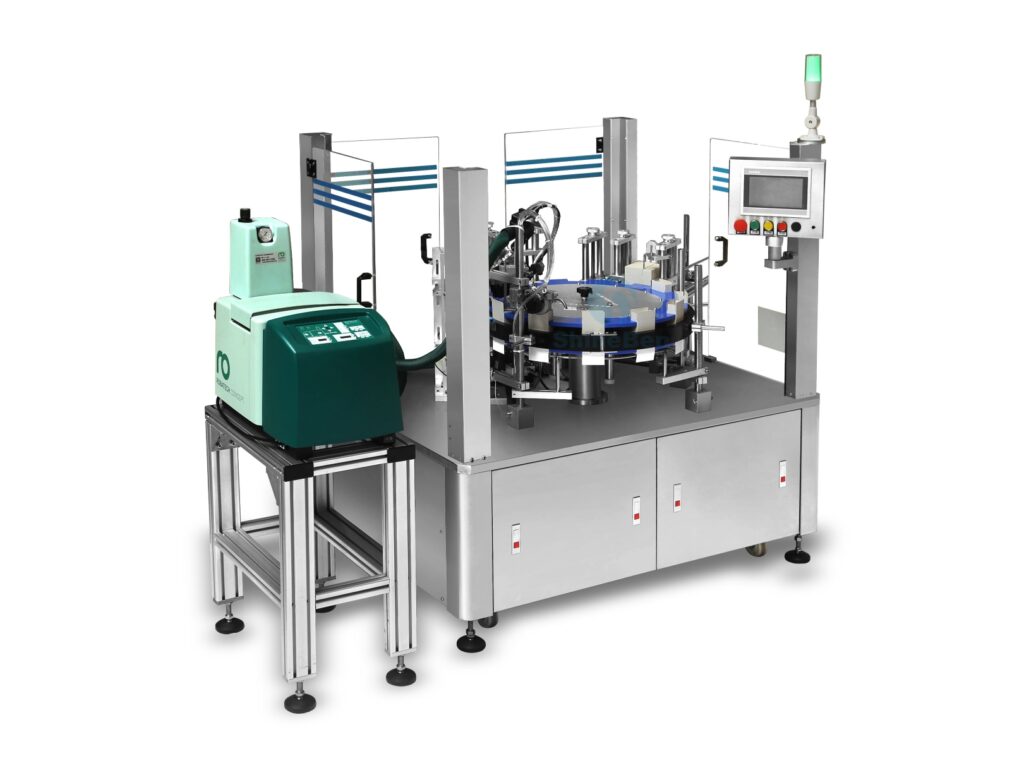
How a cartoner works
Flat cartons are stacked in a magazine. A vacuum system picks one carton at a time and opens it. The product, often with a folded leaflet, is loaded into the open carton, and the carton is closed and sent out to the next machine, usually a case packer. The SBM-CMH-I60, I100 and C130 can also be fitted with marking systems or Track & Trace functions and linked to a labeling machine.
1. Horizontal or vertical?
Horizontal cartoners (also called end load or side load cartoners) push the product into the open end of a carton lying on its side. They suit blisters, pouches, sachets, bottles, vials and other products that can be pushed in a straight line, in food, dairy, cosmetics, home goods, hardware, electronic parts and pharmaceuticals. Our horizontal models are the SBM-CMH-I100, SBM-CMH-I60, SBM-CMH-C130 and SBM-CMH-C200.
Vertical cartoners load the product from the top into a carton standing upright. Our rotary models, the SBM-CMV-R60, SBM-CMV-R80 and SBM-CMV-R80TI, carry each carton through a compact 12-station turntable that handles loading, leaflet feeding, coding and inspection. The cartons ride in buckets held by suction cups, so they do not rub against rails, which protects delicate printed cartons. The SBM-CMV-H80 top load cartoner is a larger machine, 4.1 m long, for the same kind of loading.
As a rule of thumb: high output and products that slide in easily point to a horizontal cartoner; lower output, a small footprint, or products that are easier to drop in than to push point to a vertical one.
2. What speed do you need?
Start from the machine before the cartoner. If a blister machine, a sachet sorter or a counting line delivers a set number of packs per minute, divide by the number of packs in each carton. That is the carton speed you need, plus a margin, because real speed depends on the product and the carton style.
- Up to 50–60 cartons per minute: the vertical models (20–50 or 20–60), the SBM-CMV-H80 (20–60) or the horizontal SBM-CMH-I60 (20–60) for large cartons
- Up to 100 cartons per minute: the SBM-CMH-I100 (40–100)
- Up to 130 cartons per minute: the continuous motion SBM-CMH-C130 (80–130)
- Up to 160 cartons per minute: the continuous motion SBM-CMH-C200 (100–160)
Intermittent machines such as the I60 stop the carton briefly at each station. Continuous motion machines keep the cartons moving, which is how the C130 and C200 reach higher speeds.
3. How big is your carton?
Check your carton against each machine’s size range in the table below. Small cartons, from 20 mm, fit the vertical rotary models. Large, flat cartons up to 320 × 250 mm fit the SBM-CMH-I60. Every range can be customized, so a carton just outside a range is worth asking about. Carton board of 260–350 g/m² suits every model; some take up to 400 or 450 g/m².
4. Tuck-in or glued cartons?
Tuck-in closures fold the flaps into the carton and need no glue. Hot-melt closures glue the flaps, which gives a firmer, tamper-evident carton. The SBM-CMH-I60, I100 and C130 are available with either; ask us about the C200. On the vertical rotary models you choose by model: the SBM-CMV-R80TI closes with tuck-in flaps, and the SBM-CMV-R80 with hot melt.
5. Leaflets, power and space
- Leaflets: most models can insert a leaflet. Check your leaflet size against the machine; the C130 and I60 specifications do not list a leaflet unit, so ask if you need one.
- Power supply: the I100 and the vertical rotary models run on 220 V. The C130, C200, I60 and CMV-H80 need 380 V three phase. All need compressed air at 0.5–0.8 MPa.
- Floor space: the vertical rotary models are about 1.7 m long; the horizontal models range from 3.1 m (I100) to 5.8 m (I60).
Our cartoners compared
| Loading | Speed (cartons/min) | Carton size L × W × H (mm) | Power supply | Size L × W × H (mm) | Weight | |
|---|---|---|---|---|---|---|
| SBM-CMV-R60 | Vertical, rotary | 20–50 | 20–200 × 20–80 × 20–80 | 220 V, 1 phase | approx. 1698 × 1170 × 1600 | approx. 450 kg |
| SBM-CMV-R80 | Vertical, rotary, hot melt | 20–60 | 20–200 × 20–130 × 20–130 | 220 V, 1 phase | approx. 1698 × 1170 × 1600 | approx. 450 kg |
| SBM-CMV-R80TI | Vertical, rotary, tuck-in | 20–60 | 20–200 × 20–130 × 20–130 | 220 V, 1 phase | approx. 1698 × 1170 × 1600 | approx. 450 kg |
| SBM-CMV-H80 | Vertical, top load | 20–60 | 30–180 × 20–120 × 30–160 | 380 V, 3 phase | 4100 × 970 × 1600 | 1500 kg |
| SBM-CMH-I60 | Horizontal, intermittent | 20–60 | 120–320 × 100–250 × 20–80 | 380 V, 3 phase | 5800 × 1740 × 1900 | 2200 kg |
| SBM-CMH-I100 | Horizontal | 40–100 | 70–220 × 20–85 × 15–50 | 220 V | 3100 × 1100 × 1700 | 1500 kg |
| SBM-CMH-C130 | Horizontal, continuous | 80–130 | 60–220 × 40–85 × 16–60 | 380 V, 3 phase | 3800 × 1600 × 1700 | 2000 kg |
| SBM-CMH-C200 | Horizontal, continuous | 100–160 | 70–200 × 40–120 × 20–80 | 380 V, 3 phase | 4900 × 1600 × 1900 | 2600 kg |
Before and after the cartoner
A cartoner rarely works alone. Before it, a sachet sorter, a blister machine or a counting machine feeds it. After it, a case packer and a case sealer pack the cartons for shipping. When we plan a complete line, we match the speeds of all these machines so none of them waits for another.
Common questions
What is the difference between an end load and a side load cartoner?
None in practice: both names describe a horizontal cartoner that pushes the product into the open end of the carton. Our SBM-CMH-I60 is sold as a side load cartoner and works this way.
Can one cartoner run several carton sizes?
Yes, within its size range, with a size changeover. The SBM-CMH-C130 is designed for simple, quick changeovers. Tell us all the carton sizes you plan to run, so we can choose a model that covers them.
What happens if a carton or a product is missing?
The SBM-CMH-C130 has no-carton/no-load and no-product/no-carton control: it does not load product when there is no carton, and does not use a carton when there is no product. Ask us about the same function on other models.
The best way to choose is to test. Send us your product, cartons and leaflets, and we will run them on the cartoner and send you a video before you decide.